
How to Write a Resume Objective for Freshers With No Experience
24 Jul 2026 · 9 min read
Written by Anil Sahu · Reviewed by Ritesh Panda
Last reviewed: 5 Aug 2026
You've got zero work experience, a resume template that came with a placeholder objective, and a deadline to apply before applications close. That objective line — the one recruiters skim in the first four seconds — either gets you a second look or gets you filed under 'generic.'
The good news: an objective for a no-experience resume isn't supposed to describe a career you don't have yet. It's supposed to tell the recruiter exactly what you can already do, and exactly why you're applying for this role, in two lines flat.
Here's how to write one that actually reads like it belongs to a specific person applying for a specific job — not a fill-in-the-blank line copied from the tenth resume template you found on Google.
Why Most 'Fresher' Objectives Get Skipped
Open ten fresher resumes and you'll find the same objective, word for word: 'Seeking a challenging position in a reputed organization where I can utilize my skills and contribute to organizational growth.' It says nothing. No skill, no tool, no role, no company, nothing a recruiter can act on.
Recruiters and ATS software both scan for specifics — a language, a framework, a certification, a number. A sentence built entirely out of adjectives ('dynamic,' 'challenging,' 'reputed') doesn't match any of that, so it gets treated as filler and skipped in the same four seconds it took to read it.
The fix isn't to sound more impressive. It's to sound more specific.
A Two-Line Rewrite That Changed the Response Rate
Suppose a B.Sc Computer Science fresher applies to 40 companies over two months with an objective that reads 'Seeking a challenging position in a reputed IT company to utilize my technical skills for organizational growth,' and hears back from exactly one.
Now suppose the same resume, same projects, same marks — but the objective is rewritten to 'B.Sc (CS) fresher skilled in Python and MySQL, seeking a Software Support Engineer role to help resolve client issues and maintain application uptime.' Nothing else on the page changed. But the objective now matches an actual job title recruiters are searching for, and names two tools an ATS can match against the job description — often the difference between a resume that gets opened and one that gets auto-filtered before a human sees it.
What an Objective Has to Do When You Have No Experience
Without work history to lean on, your objective is doing a job your experience section can't: proving you already have something relevant, before the recruiter even reaches your projects or education.
That means it needs three things in roughly two lines: what you know (a skill, tool, or subject you're actually trained in), what role you want (specific enough that it's clearly not a mass-blast application), and what you'd bring to it (a concrete outcome, not a feeling).
This is also exactly what tools like an ATS resume checker are scanning for — keyword-role alignment, not enthusiasm. If your objective doesn't mention the skill or role, the ATS has one less signal that you're a match.
It's also the only part of the page a recruiter reads before deciding whether the rest is worth their time — which is a lot of pressure for two lines, but also means it's the highest-leverage edit you can make.
The Formula: Skill + Tool + Role + Value
You don't need a creative writing degree for this — you need a formula you can fill in every time you apply. Use: [Degree/skill] + [tool or method you know] + [role you're targeting] + [what you'd deliver].
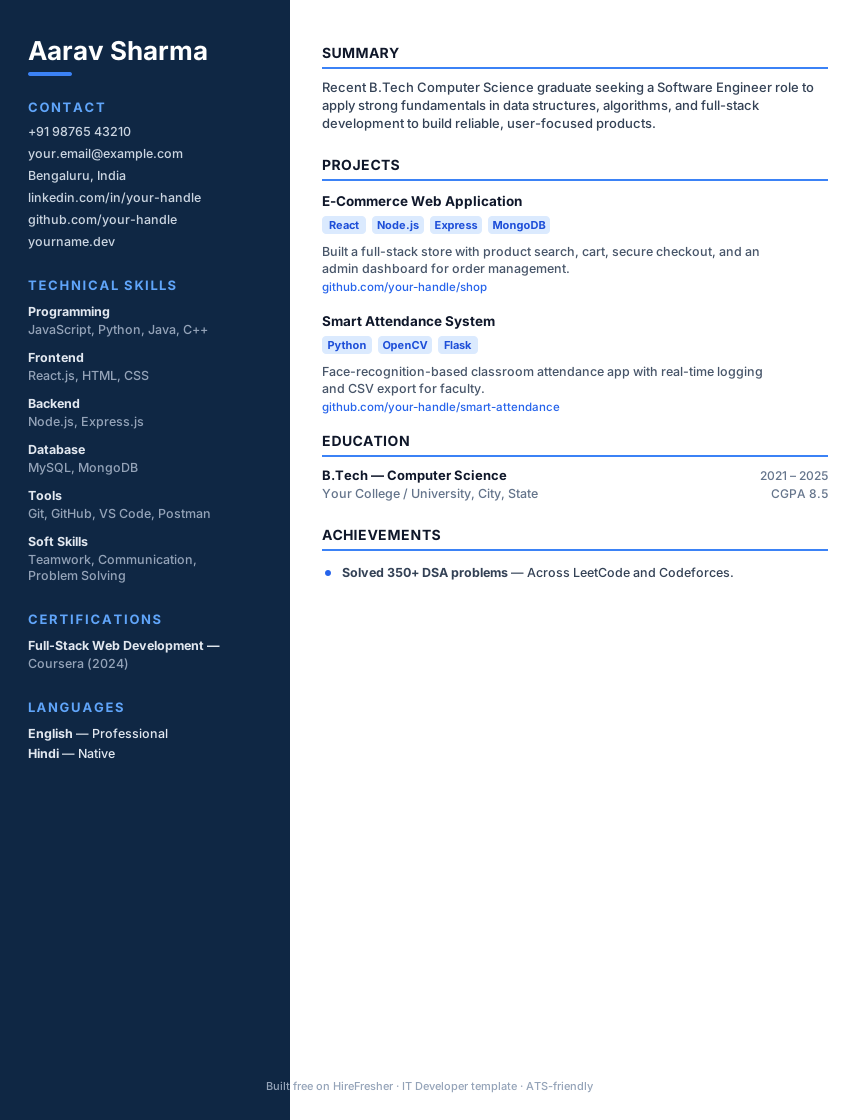
Example: 'B.Tech graduate skilled in Python and SQL, seeking a Data Analyst role to turn raw datasets into reports that support faster business decisions.' Four parts, one sentence, zero filler adjectives.
Keep the tool specific — 'Excel' or 'Python' tells a recruiter something concrete; 'computer skills' or 'good communication' tells them nothing, because almost every other applicant has typed the exact same phrase.
Swap in your own degree, tool, and role and the same skeleton works whether you're applying for a support engineer job, a content role, or a core-branch job at a PSU.
Before and After: Objectives by Field
Generic objectives fail the same way across every field — vague language standing in for a real skill. Here's what the fix looks like in practice:
- Before: 'Seeking a position in the IT industry to enhance my skills.' After: 'B.Tech (CSE) fresher with hands-on projects in Java and MySQL, seeking a Software Trainee role to build and maintain reliable backend features.'
- Before: 'Looking for a challenging role in the marketing field.' After: 'BBA graduate trained in Canva and basic SEO, seeking a Marketing Intern role to support content and social campaigns with measurable engagement.'
- Before: 'To work in a reputed organization utilizing my skills.' After: 'B.Com graduate with strong Excel and Tally skills, seeking an Accounts Executive role to support accurate, on-time reconciliations.'
- Notice the pattern: degree, one or two named tools, one specific role title, one outcome. Nothing about 'growth' or 'dynamic environments.'
Simple resume objective examples (copy-paste)
If you just want a simple objective for a resume with no experience to adapt right now, copy one of these and swap in your own degree, tool, and role. For 50+ more grouped by degree and role, see our resume objective examples for freshers library.
- IT: 'Computer Science graduate skilled in Java and web development, seeking a Software Developer role to build reliable, user-focused applications.'
- Commerce: 'B.Com graduate proficient in Tally and Excel, seeking an Accounts Executive role to support accurate, on-time finance operations.'
- Management: 'BBA graduate with strong communication and coordination skills, seeking a Sales/Marketing trainee role to help meet team targets.'
- Core engineering: 'Mechanical Engineering graduate skilled in AutoCAD, seeking a Design Trainee role to contribute to product design and testing.'
- Generic (any field): 'Motivated graduate seeking an entry-level [role] position to apply my skills in [skill 1] and [skill 2] and grow into a dependable team member.'
Where It Goes and How Long It Should Be
Place it directly under your name and contact details, before education or projects — it's the first thing read, so it should be the most tailored line on the page.
Keep it to one to two lines, roughly 30–40 words. Recruiters spend seconds here; a paragraph reads as padding, not effort.
Recruiters reading on a phone or a cramped ATS preview pane often see only the top third of the page — so this is not the place to experiment with three lines when two will do.
If you're applying to different roles, write a different objective for each one. A resume builder that lets you edit and re-download quickly — like HireFresher's free resume builder for freshers — makes this a two-minute edit instead of a reason to send the same resume everywhere.
Mistakes That Quietly Cost You Shortlists
Even a well-intentioned objective can undo itself with small habits recruiters have seen too many times.
- Naming a different company or role than the one you're applying to (a copy-paste leftover from a previous application).
- Listing five skills with no role — it reads like a skills dump, not an objective.
- Starting with 'To secure a position' — every recruiter has read this exact opening hundreds of times.
- Writing about what you want to gain ('to enhance my knowledge') instead of what you can already contribute.
- Copying the exact wording from a resume template site without changing the company or field it was originally written for.
- Making it three or four lines long — the summary section is for depth, the objective is for a hook.
The One Thing We See Most
On fresher resumes, the objective line is where the same mistake shows up again and again: a sentence that could be pasted onto any resume in the country without changing a word.
The freshers who get called back aren't the ones with the most polished-sounding objective — they're the ones whose two lines make it obvious they read the job post before writing them. If you only fix one line on your resume today, make it this one, and keep it specific to the actual role in front of you.
7 Ready-to-Use Objective Examples (by Branch)
Find the line closest to your branch and target role, then swap in your own tools and the exact job title you're applying for.
- Mechanical (production): 'B.E. Mechanical graduate skilled in AutoCAD and SolidWorks, seeking a Graduate Engineer Trainee role in production to support process improvements and help reduce machine downtime.'
- Civil engineering: 'B.Tech Civil graduate trained in AutoCAD and STAAD.Pro, with a final-year project on low-cost residential design, seeking a Site Engineer role to assist in planning and on-site execution.'
- Electronics (ECE): 'B.Tech ECE fresher skilled in Embedded C and Arduino, with an IoT-based smart energy meter project, seeking an Embedded/Testing Engineer role to build and validate reliable hardware-software systems.'
- MCA (software): 'MCA graduate proficient in Java, Spring Boot, and MySQL, seeking a Junior Backend Developer role to build and maintain scalable REST APIs.'
- B.Sc Chemistry: 'B.Sc Chemistry graduate with hands-on titration and instrumentation lab experience, seeking a Quality Control Analyst role in a pharma or FMCG lab to ensure accurate, compliant testing.'
- B.A. English: 'B.A. English graduate with strong writing and editing skills from two years on the college magazine, seeking a Content Writer role to produce clear, SEO-friendly articles.'
- B.Pharm: 'B.Pharm graduate with a solid grounding in pharmacology and regulatory basics, seeking a Pharmacovigilance Associate role to support accurate adverse-event case processing.'
FAQs
What should a resume objective say if I have absolutely no work experience?
Name your degree, one or two skills or tools you've actually used (even from academic projects), the specific role you're applying for, and one outcome you'd aim for. Skip experience entirely — an objective for freshers isn't meant to describe a work history.
How long should a fresher's resume objective be?
One to two lines, around 30-40 words. Longer than that starts to read like a summary, and recruiters skim this section in seconds.
Should I use the same objective for every job application?
No — swap the role title and, where relevant, the skill to match each job post. A generic objective used across applications is one of the fastest ways for a recruiter to tell a resume was mass-sent.
Is an objective necessary, or can I just skip straight to skills and projects?
It's optional but useful when you have no experience — it gives the recruiter context before they reach your projects section. If you'd rather skip it, a short professional summary can do the same job; see what an ATS resume actually needs.
Do ATS systems actually scan the objective line?
Yes — ATS software scans the entire resume text for keyword matches against the job description, and the objective is usually the first block it reads. Running your resume through an ATS checker before applying shows you exactly which keywords are missing.
Build your resume free
Create your free ATS-friendly resume in minutes using our free resume builder.
Create free resumeJob Alerts
Get new resume tips & fresher job-prep guides — free, no email needed.