
CV for Freshers with No Experience: What to Actually Put On It
28 Jul 2026 · 8 min read
Written by Anil Sahu · Reviewed by Ritesh Panda
Last reviewed: 28 Jul 2026
You've got zero job experience and a blank CV staring back at you. Feels like a trap, right? Companies want experience, but nobody hands a fresher a job just to get some.
Here's the part most freshers miss: recruiters hiring for entry-level roles don't expect a work history. What they're actually screening for is potential — proof you can learn fast, apply your degree to something real, and communicate clearly on paper. A CV built around projects, skills, and academic wins can beat a generic template any day, experience section or not.
This guide breaks down exactly what to put on a CV for freshers with no experience, section by section, so you stop staring at a blank page and start building something that actually gets shortlisted.
Why 'No Experience' Isn't the Problem You Think It Is
Recruiters hiring for fresher roles already expect a thin work history — that's the entire point of the job title. What actually gets a CV rejected isn't a missing 'Experience' section; it's a CV that looks unfinished, has no clear structure, or repeats the same three lines of 'hardworking and dedicated team player' that every other fresher writes.
Think about it from the recruiter's side: they're hiring for potential, not a list of past job titles. A CV built for freshers should lean hard into what you do have — your degree, your final-year project, the six-week internship, the fest you organised, the Excel model you built for a college budget. A resume vs CV built the right way turns 'nothing to show' into a fairly solid case.
The Sections Every Zero-Experience CV Needs
The biggest mistake is copying a senior professional's CV format and simply deleting the 'Work Experience' heading. That leaves an obvious hole where a recruiter expects content. Instead, build your CV around a structure designed for freshers from the ground up — one where projects, education, and skills carry the weight that a job history normally would.
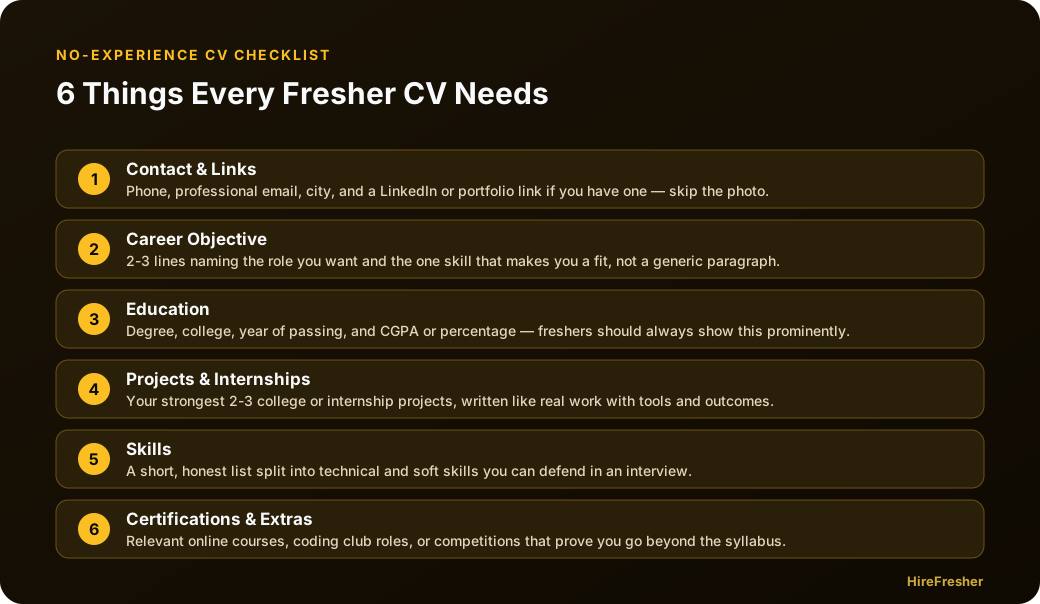
Use the checklist below as your section-by-section guide. Every item on it replaces the space a work-experience block would otherwise occupy, so nothing on the page looks empty or like an afterthought.
Turn Your Final-Year Project Into 'Experience'
Most freshers describe their college project in one flat line and move on — that's a wasted opportunity. Recruiters read project lines the same way they'd read a job responsibility, so write them the same way: what you built, what tools you used, and what the result was.
Compare these two versions of the same project. Before: 'Made a project on inventory management using Python.' After: 'Built a Python and SQL-based inventory management system for a mock retail dataset, cutting manual stock-count errors by design, and presented it to a 3-member faculty panel.' Same project, completely different impression.
Do this for your 2–3 strongest projects, whether they're from your final year, a hackathon, or a college assignment you actually put effort into. Read more on how to write a project description in your resume if you want a deeper breakdown.
- Quantify wherever you can — errors reduced, time saved, users tested, marks scored
- Name the actual tools and technologies, not just 'a project'
- Mention the outcome or audience — presented to faculty, deployed for a college club, used by 20 students
Write a Career Objective That Doesn't Sound Copy-Pasted
Most freshers write 'Seeking a challenging position to utilise my skills and contribute to organisational growth.' Recruiters have read that exact sentence thousands of times, and it tells them nothing about you.
Instead, name the role you're targeting, one or two concrete skills, and what you actually want to contribute — in two to three lines, not a paragraph. If you're not sure how to structure this, our guide on writing a career objective for freshers walks through real examples by branch and role.
Skills: List What You Can Actually Prove
Split your skills into two short lists — technical and soft — instead of one long, vague paragraph. A recruiter scanning for 'Excel' or 'Python' shouldn't have to hunt for it inside a sentence about your personality.
Only list a skill if you can defend it in an interview. If you write 'leadership,' be ready to talk about the coding club you ran or the group project you led. Interviewers love asking freshers to prove exactly the skill they listed, and a shaky answer here hurts more than leaving the skill off entirely.
- Technical: languages, tools, software (e.g. Python, Excel, AutoCAD, Tally)
- Soft skills: communication, teamwork, time management — backed by one real example each
- Certifications: relevant online courses (Coursera, NPTEL, Google) if they relate to the role
Format for the ATS, Not Just the Human Eye
Many freshers lose the shortlist before a human even opens the CV, because of ATS parsing issues — tables, text boxes, columns, icons, and unusual fonts that applicant tracking systems can't read correctly.
Run your draft through a free ATS checker before sending it anywhere, and stick to the guidelines in our ATS resume format for freshers: single-column layout, standard section headers like 'Education' and 'Skills,' reverse-chronological education, and a PDF export rather than a scanned image or a heavily designed template.
The One Thing We See Most
The single biggest mistake on 'no experience' CVs is leaving the space where work history would go completely empty instead of relabelling it. A blank section reads as unfinished; a 'Projects' or 'Academic Work' section in that same spot reads as intentional.
You don't need a fabricated internship or an inflated job title — you need a CV that's honestly built for where you actually are right now. Build yours with the free resume builder for freshers: in India it's free to build, preview, and download every template. Downloads are paid only for users outside India (from $5).
FAQs
Can I actually get shortlisted with a CV that has zero work experience?
Yes. Fresher roles are built around the assumption of no prior job history. What matters is whether your projects, skills, and education are presented clearly and specifically — a well-structured CV with no jobs listed tends to read far better than a vague one that name-drops a random internship.
Should I add a fake internship to fill the gap?
No — never fabricate experience. It's easy to catch in an interview and can get you rejected or blacklisted. Use real academic projects, coursework, and extracurriculars instead; they carry more weight than recruiters expect.
How long should a fresher CV with no experience be?
One page. With no work history to list, there's rarely enough genuine content to justify a second page, and a padded one-pager looks worse than a tight, well-organised single page.
What if I don't even have a college project or internship to write about?
Use coursework assignments, a college fest you helped organise, a certification course project, or volunteer work. Anything where you applied a skill and produced a result can be written up the same way as a project.
Is a CV different from a resume for someone with no experience?
In India the terms are mostly used interchangeably for freshers, but there are small formatting differences worth knowing — see our full resume vs CV breakdown.
Build your resume free
Create your free ATS-friendly resume in minutes using our free resume builder.
Create free resumeJob Alerts
Get new resume tips & fresher job-prep guides — free, no email needed.