
Resume Rejected? 7 Reasons Why & How to Fix It Today
14 Jul 2026 · 8 min read
Written by Anil Sahu · Reviewed by Ritesh Panda
Last reviewed: 14 Jul 2026
Your resume is getting rejected. Here's why 😐 — and the good news is, it's probably not you. If you've applied to dozens of jobs and heard nothing back, the issue is almost always your resume, not your talent.
'Why is my resume getting rejected' is one of the most common questions freshers ask, and nearly every time the answer comes down to a handful of fixable issues. Think of this as advice from a senior colleague over coffee — let's go through the 7 real reasons resumes get rejected and how to fix each one today.

1. Your Resume Isn't Passing the ATS Scan
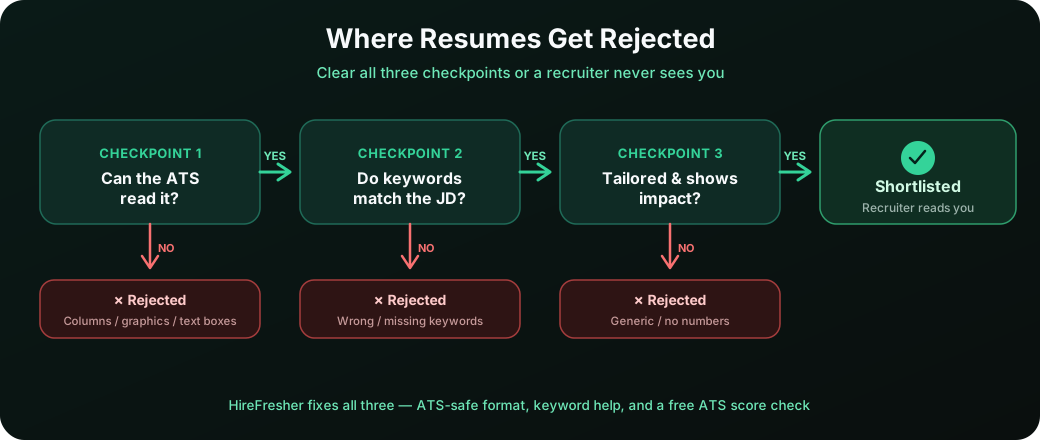
The problem: Most companies use an Applicant Tracking System (ATS) to filter resumes before a human sees them. Text boxes, columns, layout tables, or heavy graphics can make the software misread your resume — or skip sections entirely. You could be the perfect candidate and still get auto-rejected because a bot couldn't read it. (More on this: What Is an ATS Resume?)
The fix: Switch to a single-column, text-based layout. Use standard fonts (Calibri, Arial, Times New Roman). Save as .docx or a PDF exported directly from Word — avoid design-tool PDFs (Canva, Photoshop) unless the employer allows them. This one change fixes rejection for a huge number of applicants.
2. You're Not Using the Right Keywords
The problem: ATS software and recruiters search for specific terms from the job description. If the posting asks for 'Python' and 'data analysis' but your resume says 'programming' and 'analytics', you may not surface as a match — even if you genuinely have those skills.
The fix: Read the job description carefully and mirror its exact language in your skills, summary, and project sections. Don't stuff keywords — just make sure the specific tools and terms in the posting also appear, in the same wording, somewhere in your resume.
3. Your Resume Is Generic, Not Tailored
The problem: Sending the same resume to 50 companies feels efficient, but it backfires. A generic resume reads as generic to recruiters too — it doesn't speak to the role, so it's easy to pass over.
The fix: You don't need to rewrite everything for each application. Just adjust your objective/summary and reorder skills and projects so the most relevant ones for that specific job appear first. Fifteen minutes of tailoring per application dramatically improves your response rate.
4. Your Bullet Points Don't Show Impact
The problem: Lines like 'Responsible for managing social media' or 'Worked on a Python project' say what you did, not how well. Without outcomes or numbers, your experience blends into every other resume.
The fix: Rewrite bullets as action verb + what you did + tool used + measurable result. E.g. 'Managed the social media calendar, increasing engagement by 25% over 3 months.' Even estimated numbers beat none. See how to write project descriptions.
5. Your Resume Has Formatting or Consistency Errors
The problem: Inconsistent date formats, mismatched font sizes, misaligned bullets, or spelling errors seem small but quietly damage credibility. With hundreds of resumes to review, recruiters don't need a reason to move on.
The fix: Do a dedicated formatting pass separate from content edits. Make every date follow one format ('Jan 2024 – Mar 2024'), every heading one style, every bullet consistent punctuation. Read the whole resume out loud once — it catches errors your eyes skip.
6. You're Missing Key Sections Recruiters Expect
The problem: Recruiters scan for a predictable structure — contact info, summary, education, skills, experience/projects, certifications. If a section is missing (no skills section, or contact details buried in a header the ATS can't read), an otherwise strong profile looks incomplete.
The fix: At minimum include contact information (in the main body, not just a header), a short summary/objective, education, technical/core skills, relevant experience or projects, and certifications. This is what recruiters at every level expect to find quickly.
7. You're Applying to Roles You're Not Aligned With
The problem: Sometimes it isn't the resume — it's the fit. Applying broadly to roles that don't match your skills or level means even a well-written resume won't convert, because the mismatch is obvious to the recruiter.
The fix: Be honest about where your skills genuinely align. It's fine to stretch for slightly senior roles, but if a posting needs 5 years and you have none, redirect that energy to realistic matches — your response rate and your confidence both improve.
Your Resume Fix-It Checklist
Before you send your resume out again, run through this list:
- Single-column layout — no text boxes, tables, or heavy graphics
- Standard font (Calibri, Arial, Times New Roman), consistent sizing
- Contact details in the main body, not just a header/footer
- Summary/objective tailored to the specific role
- Keywords from the job description reflected in skills and experience
- Every bullet has an action verb and a measurable result where possible
- Consistent date format throughout
- No spelling or grammar errors (read it out loud once)
- All key sections present: contact, summary, education, skills, experience/projects, certifications
- File saved as .docx or Word-exported PDF, named FirstName_LastName_Resume
- You're applying to roles genuinely aligned with your level
You're Closer Than You Think
Getting rejected again and again is discouraging, and it's easy to doubt yourself. But in most cases the gap between 'no response' and 'shortlisted' isn't your talent — it's whether your resume is structured, tailored, and clear enough for a recruiter (or a bot) to see that talent.
Not sure if your resume has these issues? Run it through the free ATS checker for an instant score, or rebuild it free on HireFresher with an ATS-safe template. Fix these seven issues and you'll notice the difference almost immediately.
One turnaround — 40 applications to 3 calls
Take Rahul, a mechanical fresher who applied to nearly 40 companies and heard nothing back — he assumed the market was just brutal. On a whim he ran his resume through an ATS checker and saw the real problem: it scored 38%, because a two-column layout, a photo, and a skill-bar graphic were scrambling how the software read it. He rebuilt it as a clean, single-column resume, the score jumped past 90%, and within two weeks he had three interview calls. His talent hadn't changed — only whether a machine could read it.
This is an illustrative example, but it's the single most common pattern we see: the resume, not the candidate, was the problem — and it was a fixable one.
FAQs
Why does my resume keep getting rejected?
Usually one of seven fixable issues: it's not ATS-readable, it's missing job-description keywords, it's too generic, the bullets show no measurable impact, it has formatting/consistency errors, it's missing key sections, or you're applying to roles that don't match your level.
How do I know if an ATS rejected my resume?
You usually won't get told directly, but signs include zero responses despite being qualified. Run your resume through a free ATS checker — it flags formatting the parser can't read and keywords you're missing.
Does tailoring my resume for each job really help?
Yes. You don't need a full rewrite — adjusting your objective and reordering skills/projects so the most relevant appear first, plus matching the posting's keywords, meaningfully improves your response rate.
What's the fastest fix if my resume is getting rejected?
Switch to a single-column, text-based layout with standard fonts and standard section headings, and mirror the job description's keywords. That alone gets many previously-rejected resumes past the ATS.
Build your resume free
Create your free ATS-friendly resume in minutes using our free resume builder.
Create free resumeJob Alerts
Get new resume tips & fresher job-prep guides — free, no email needed.