
How to Write a Resume Summary for Freshers With No Experience
20 Jul 2026 · 8 min read
"But I have no experience — what do I even write at the top of my resume?" We hear this from freshers every single week. The blank space under your name feels impossible to fill when you have never held a full-time job.
Here is the good news: a resume summary for a fresher is not about listing jobs you have not had. It is about packaging what you *do* have — your degree, your projects, your skills, your internships, and your direction — into three or four confident lines that make a recruiter keep reading.
This guide gives you a plug-and-play formula, real before-and-after examples, ready-to-copy summaries for common branches, and the small mistakes that quietly get freshers filtered out. No fluff, no fake experience — just a summary that sounds like a capable person who is ready to work.
What a resume summary actually is (and what it is not)
A resume summary is a short 2–4 line paragraph at the very top of your resume, right under your name and contact details. It answers one question in a recruiter's head: "Why should I read the rest of this?"
For experienced people it summarises years of work. For a fresher with no experience, it does something slightly different — it summarises your *potential*: your education, your strongest skills, the projects that prove those skills, and the role you are aiming at. Think of it as your 10-second elevator pitch in text form.
One thing it is NOT: it is not the same as a career objective. An objective says what *you* want ("seeking a role to grow my skills"). A summary says what *you bring* to the company. As a fresher you can use either, but a summary usually reads stronger. If you are torn between the two, our guide on the career objective for freshers breaks down when each one wins.
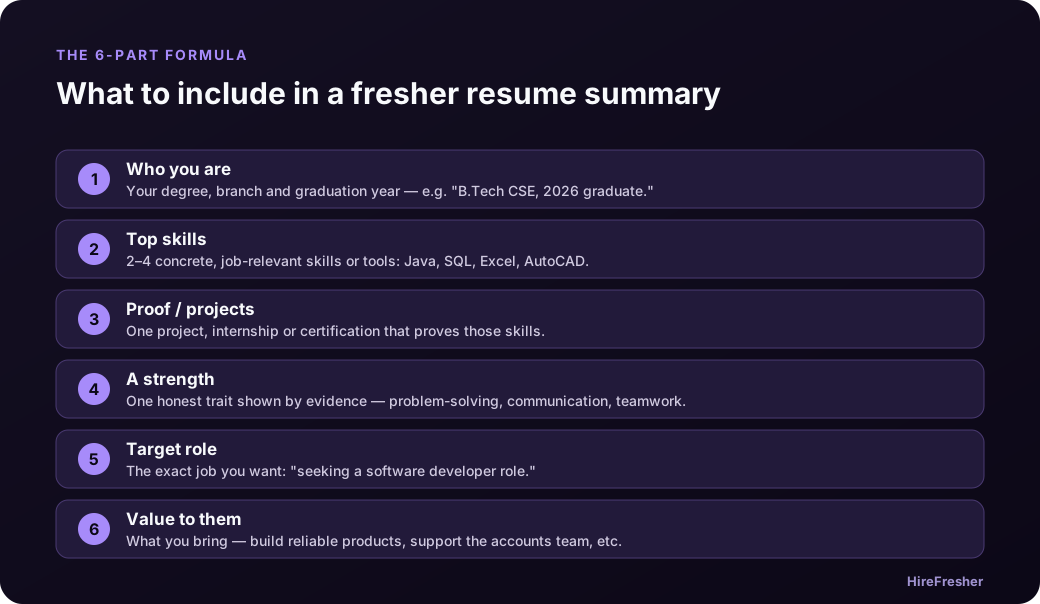
The 6-part formula that works for zero-experience freshers
You do not need to be a great writer. You need a template. Almost every strong fresher summary is built from the same six ingredients — you just fill in your own details. Not every line needs all six, but hitting four or five of them makes the summary feel complete.
Before and after: turning a weak summary into a strong one
Here is a real pattern we see constantly. A fresher writes something safe and generic, and it disappears into the pile. A few edits make it specific and confident.
BEFORE (weak): "Hardworking and dedicated fresher looking for a job in a reputed company where I can utilise my skills and grow my career." — This says nothing. Every second resume opens like this, and it names no skill, no branch, no role.
AFTER (strong): "B.Tech (Computer Science, 2026) graduate skilled in Java, SQL and React, with two academic projects including a college event-management web app. Comfortable with DSA fundamentals and Git. Seeking a software developer role to build reliable, user-focused products." — Same person, zero jobs, but now there is a branch, real tools, a project, and a target role.
Notice the difference is not talent — it is *specificity*. Numbers, tool names, and a named role do the heavy lifting. If you want more full examples to model yours on, browse our fresher resume examples.
Copy-ready summary examples by branch
Use these as starting points, then swap in your own projects, tools, and marks. Keep it to 2–4 lines.
- Computer Science / IT: "BCA graduate (2026) with hands-on projects in Python and MySQL, including a library-management system. Familiar with OOP, DBMS and basic web development. Eager to start as a junior software developer and grow into full-stack work."
- Mechanical: "Mechanical Engineering fresher skilled in AutoCAD and SolidWorks, with a final-year project on a low-cost solar dryer. Strong in thermodynamics and manufacturing basics. Looking for a design or production trainee role."
- Commerce / B.Com: "B.Com graduate with a strong grip on accounting, Tally and MS Excel, plus a 2-month internship in accounts payable. Detail-oriented and comfortable with GST basics. Seeking an accounts executive role."
- Non-technical / BA: "BA English graduate with strong written and verbal communication, content-writing for the college magazine, and a certification in digital marketing. Seeking a content or client-facing associate role."
- Data / Analytics aspirant: "Statistics graduate (2026) skilled in Excel, SQL and Power BI, with a dashboard project analysing college placement data. Strong analytical mindset. Targeting a data analyst trainee role."
How to sound experienced when you are not
You have more raw material than you think. The trick is to mine your last three years of college for anything that shows real work — and phrase it in professional language, not student language.
Pull from: academic and final-year projects, internships (even unpaid or 15-day ones), college fests you organised, freelance or volunteer work, certifications (Coursera, NPTEL, Google), and technical clubs. A project where you built something counts. Leading a team of 5 for a fest counts. A dashboard you made for practice counts.
The language upgrade matters too. "Made a project" becomes "built a full-stack event-management app using React and Node." "Good at Excel" becomes "skilled in Excel including VLOOKUP and pivot tables." This same principle drives strong bullet points too — see how to write a project description in resume to turn a class project into a recruiter-ready line.
One caution: never invent experience. Do not claim a job you did not have or a skill you cannot demonstrate in an interview. "No experience" handled honestly beats fake experience that collapses in the first technical round.
Mistakes that quietly get freshers rejected
Most rejected summaries are not bad — they are forgettable, or they trip the ATS. Avoid these:
- Generic filler: "hardworking, dedicated, team player" with no proof. Adjectives without evidence read as empty.
- Writing it too long: a summary is 2–4 lines, not a paragraph of eight. If it is longer than a WhatsApp message, cut it.
- No target role: a summary that never names the job you want forces the recruiter to guess — and they will not.
- Keyword-free text: many companies screen with an ATS. If your summary has none of the skills from the job description, it can get filtered before a human sees it. Run yours through an ATS checker to confirm your keywords land.
- Copy-pasting a template word-for-word: recruiters have read the same generic line 500 times. Personalise it with your branch, tools, and one real project.
Where the summary sits in the rest of your resume
The summary is the hook, but it only works if the resume beneath it delivers. Keep the format clean and ATS-friendly: standard fonts, clear section headings (Summary, Skills, Projects, Education), no fancy tables or graphics that scanners choke on.
For a fresher, the order usually goes: Summary → Skills → Projects → Education → Certifications. This puts your strongest, most job-relevant material first. If you are unsure of the layout, our ATS resume format for freshers walks through a template that passes both software and human eyes.
You do not have to build all of this from scratch. Our free resume builder for freshers gives you the structure, a live preview, and three free-template PDF downloads — so your summary sits inside a resume that actually looks the part.
The one thing we see most
At HireFresher we have watched thousands of fresher resumes pass through our ATS checker and builder, and the single biggest mistake is not a lack of experience — it is the summary that says nothing. Line after line of "hardworking fresher seeking a challenging opportunity" with no branch, no tool, no project, no target role.
The freshers who get shortlisted are almost never the ones with the most impressive backgrounds. They are the ones who took the same ordinary college projects and skills everyone else has, and described them *specifically* — with a real tool, a real project, and a clear role they are aiming at. Specificity, not experience, is what makes a summary work. Write four honest, concrete lines and you are already ahead of most of the pile.
FAQs
Should a fresher with no experience use a summary or an objective?
Either works, but a summary usually reads stronger because it highlights what you bring — your skills, projects and direction — instead of only what you want. Use an objective if you are switching fields or your goal needs explaining. Keep whichever you choose to 2–4 lines.
How long should a fresher resume summary be?
Two to four lines, roughly 30–60 words. It is a hook, not a paragraph. If it is longer than a short WhatsApp message, cut the filler and keep only your degree, top skills, one proof point, and your target role.
What do I write if I have literally no projects or internships?
Lean on your degree, coursework, technical skills, certifications, and any college activity — a fest you organised, a club, volunteer work, or a self-made practice project. A dashboard you built to learn or an app you made for a class both count as real, demonstrable work.
Is it okay to say 'fresher' in my summary?
Yes, it is honest and recruiters expect it for entry-level roles. Just do not stop there — follow "fresher" with your branch, real skills, and a target role so the line has substance instead of only announcing your inexperience.
Will my summary help me pass the ATS?
It can, if it includes the keywords from the job description — the tools, skills and role names the software scans for. Mirror the language of the posting and run your resume through an ATS checker before applying to confirm those keywords are being picked up.
Build your resume free
Create your free ATS-friendly resume in minutes using our free resume builder.
Create free resumeJob Alerts
Get new resume tips & fresher job-prep guides — free, no email needed.