
Microsoft Resume for Freshers: How to Actually Get Shortlisted
12 Jul 2026 · 8 min read
Written by Anil Sahu · Reviewed by Ritesh Panda
Last reviewed: 12 Jul 2026
If you're a fresher aiming for Microsoft — SDE, Support Engineer, or an internship that converts — your resume has one job: survive the first 20 seconds. Microsoft receives thousands of fresher applications for every open role, and the earliest filter is rarely a human reading every line. It's a keyword-and-format pass, followed by a recruiter skim.
The good news: you don't need a fancy background to clear it. You need a clean one-page resume, real projects, and proof you can code. The bad news: most fresher resumes get rejected for boring, fixable reasons — a two-column template the parser can't read, a wall of soft skills, or projects described as 'made a website' with zero detail.
This guide breaks down exactly what a Microsoft-ready fresher resume looks like in India, section by section, with real before/after examples you can copy today.
How Microsoft actually screens fresher resumes
Microsoft hires freshers through three main doors: campus placements, employee referrals, and direct applications on careers.microsoft.com. All three feed into an applicant tracking system (ATS) that parses your resume into structured fields — name, education, skills, experience — before any recruiter opens it.
That parsing step is where most freshers lose. If your resume uses tables, text boxes, images, or a two-column design, the parser can scramble your details or drop them entirely. A recruiter then sees a half-empty profile and moves on. So step one isn't 'sound impressive' — it's 'be readable by a machine'. If you're unsure whether yours is, run it through an ATS checker before you apply anywhere.
The roles freshers realistically target are Software Engineer (SDE), Support Engineer, and internships (SWE Intern) that often convert to full-time. Each weights slightly differently — SDE leans on DSA and projects, Support leans on troubleshooting and communication — but the resume fundamentals are identical.
A quick example: two freshers, same college
Suppose two final-year students from the same tier-2 college apply for the same Microsoft SWE Intern role. Both have a 8.2 CGPA and know C++ and web development. Aditi lists 'Skills: C++, Java, teamwork, communication, HTML, CSS' and one project: 'E-commerce website'. Rohan lists 'C++, Java, DSA, OOP, DBMS, React, Node.js, Git, Azure basics', links a LeetCode profile with 350 solved, and describes his e-commerce project with the stack and a real outcome (payment integration, deployed on Azure, handled 200+ test orders).
Same raw ability, very different resumes. Rohan's parses cleanly, hits the DSA and Azure keywords the screen is looking for, and gives the recruiter something concrete to trust. Aditi's reads thin even though she may be equally capable. The gap here isn't talent — it's how the resume is written and formatted. That gap is completely fixable in an afternoon.
The one-page structure that works
For a fresher, one page is not a suggestion — it's the standard. You don't have the experience to justify two, and a second page signals padding. Order your sections so the strongest proof sits highest.
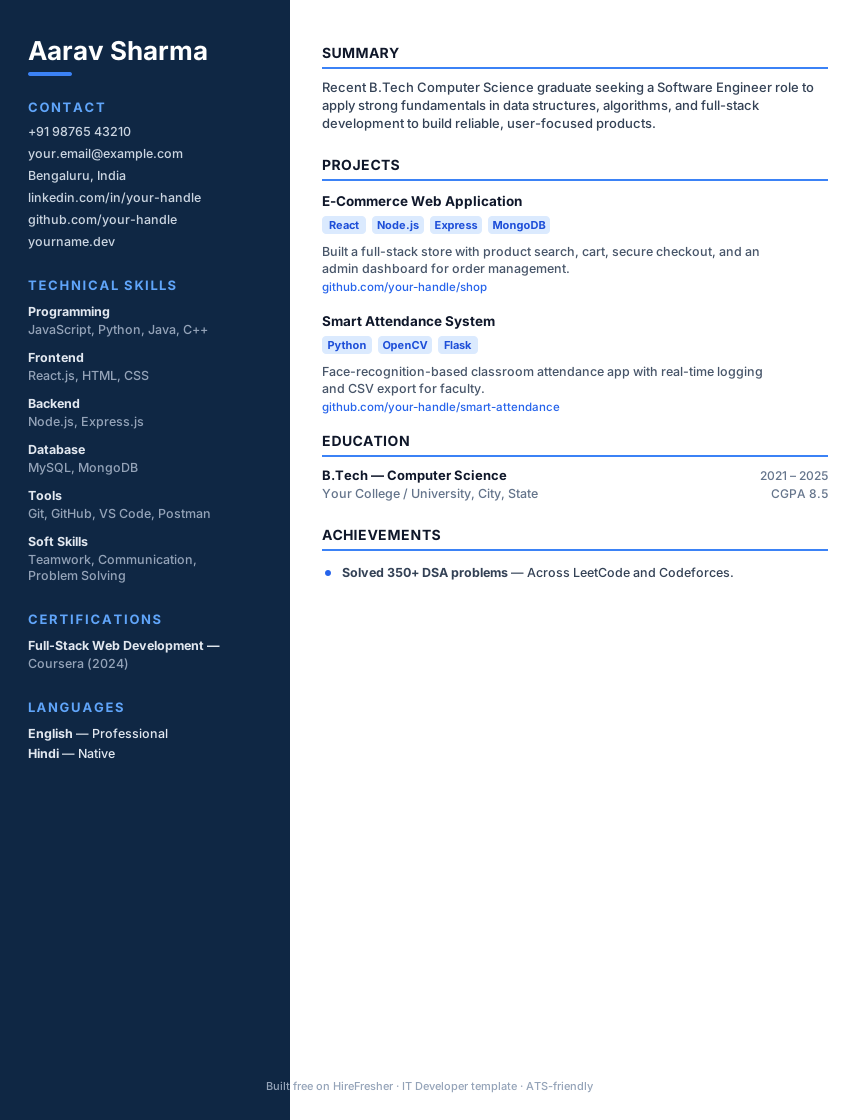
Here's the layout that consistently parses clean and reads well for a fresher applying to Microsoft:
- Header: name, one phone, one professional email, city, and clickable GitHub + LinkedIn links.
- Short summary or objective (2 lines max) — role-specific, not generic. See our note on the career objective for freshers.
- Technical Skills: languages, frameworks, tools, CS fundamentals (DSA, OOP, DBMS, OS).
- Projects: 2–3 strong ones, each with what, how, and impact.
- Education: degree, college, CGPA/percentage, graduation year.
- Achievements & Coding profiles: LeetCode/Codeforces rating, hackathons, certifications.
Skills and coding proof — what Microsoft screens for
Microsoft's engineering bar is built on data structures, algorithms, and problem-solving. Your skills section should make that obvious without you claiming to be an 'expert'. List concrete, verifiable things and skip the fluff — nobody shortlists a fresher for 'hardworking' or 'team player'.
Group skills so a recruiter scanning for keywords finds them instantly: Languages (C++, Python, Java, JavaScript), Web/Frameworks (React, Node.js, .NET if relevant), CS Fundamentals (DSA, OOP, DBMS, Operating Systems, Computer Networks), and Tools (Git, VS Code, Azure basics).
The single strongest signal a fresher can add is a coding profile with a real number: a LeetCode profile showing 300+ solved, a Codeforces rating, or a hackathon rank. That one link does more than a paragraph of adjectives, because it's proof, not a claim. Azure familiarity is a genuine plus for Microsoft specifically — even a basic cloud project or the AZ-900 fundamentals cert helps you stand out.
Projects: where freshers win or lose the shortlist
With no full-time experience, your projects ARE your experience. This is the section a Microsoft interviewer will actually ask about, so weak project descriptions cost you twice — once at screening, once in the interview.
The fix is to write each project as three things: what you built, the tech you used, and a measurable outcome. Use action verbs and numbers. Here's the difference:
Weak: 'Made a chat application using web technologies.' Strong: 'Built a real-time chat app (React, Node.js, Socket.io) supporting 100+ concurrent users; reduced message latency ~40% by switching to WebSocket connections; deployed on Azure.'
The strong version proves scope, tech depth, and impact in one line. If you want a full template for this, we broke it down in how to write a project description in resume.
The mistakes that get freshers auto-rejected
Most rejections at the resume stage aren't about talent — they're self-inflicted. These are the ones we see over and over on fresher resumes aimed at product companies like Microsoft:
- Fancy two-column templates from Canva that break ATS parsing — use a single-column ATS resume format for freshers instead.
- Projects with no tech stack and no outcome ('made a website').
- A skills list stuffed with soft skills but missing DSA, OOP, or the actual languages.
- No GitHub link, or a GitHub with empty repos.
- Typos, inconsistent tense, and a personal email like coolguy_99@ instead of your name.
- Listing every technology you've heard of — recruiters know a fresher isn't an expert in 15 stacks.
The One Thing We See Most
For company-specific applications like Microsoft, the single biggest mistake freshers make isn't a missing skill — it's a resume the parser can't even read. Beautiful two-column templates come out the other side as jumbled text, and a strong candidate looks empty on the recruiter's screen.
The second most common one: projects listed as titles with no substance. A fresher with two well-described, outcome-driven projects almost always beats a fresher with six one-line projects. Fix those two things — a clean single-column format and real project detail — and you're ahead of most of the pile before you've added a single line of code.
7 Resume Bullet Examples for SWE Freshers
Microsoft screens for problem-solving and CS fundamentals, shown through projects and code. Adapt these results-first lines to your own work:
- "Built a full-stack expense tracker (React, Node.js, MongoDB) with JWT auth and CSV export; deployed on Render, ~1,200 lines, used by 30+ classmates."
- "Implemented a URL shortener in Java + Spring Boot with Redis caching, cutting average redirect latency from 90ms to 12ms."
- "Solved 400+ LeetCode problems (rating ~1700) and ranked 2nd in the college coding contest (120 participants)."
- "Contributed 3 merged pull requests to an open-source Python CLI tool, fixing a pagination bug and adding unit tests."
- "Wrote a multithreaded C++ file downloader that splits files into 8 chunks, improving download time ~4x on large files."
- "Final-year project: real-time chat app (WebSocket, React, PostgreSQL) that held 200 concurrent users in load tests."
- Skills line: "Java, Python, C++, JavaScript · DSA, OOP, DBMS, OS, Networks · Git, Docker, REST APIs."
FAQs
Do I need a CS degree to apply to Microsoft as a fresher?
A CS or related engineering degree helps, but Microsoft cares more about demonstrated coding ability. Freshers from IT, ECE, and even non-CS branches get shortlisted with strong DSA skills, real projects, and a solid coding profile. Show the proof and the branch matters less.
What CGPA does Microsoft expect from freshers?
There's no fixed public cutoff, and campus drives vary. Many roles look for roughly 7.0+ CGPA / 60%+, but strong projects and coding profiles can offset a lower CGPA. Focus on what you can control — DSA and project depth — rather than obsessing over a number.
Should my Microsoft resume be one page or two?
One page. As a fresher you don't have the experience to justify two, and a second page usually signals padding. Cut ruthlessly: keep 2–3 strong projects, relevant skills, and education, and drop everything generic.
Does mentioning Azure or the .NET stack help for Microsoft?
Yes, genuinely — Microsoft's own cloud and stack are a natural plus. Even a small project deployed on Azure or the AZ-900 fundamentals certification is a real differentiator for freshers, as long as it's honest and you can talk about it in an interview.
Can I use the same resume for Microsoft, Amazon, and TCS?
The base resume stays the same, but tweak the summary and skill order per company. Product firms weight DSA and projects; service companies weight breadth and communication. Keep one clean ATS master and adjust the top third for each application.
Sources & verification
Recruitment stages, eligibility, and assessment patterns can vary by role, location, campus, and hiring drive. Always confirm the latest details on the official source before you apply:
Microsoft — official careers page
Last verified: 12 Jul 2026 · Reviewed by Ritesh Panda
Build your resume free
Create your free ATS-friendly resume in minutes using our free resume builder.
Create free resumeJob Alerts
Get new resume tips & fresher job-prep guides — free, no email needed.