
Google Resume Tips for Freshers: What Actually Gets You Shortlisted
12 Jul 2026 · 8 min read
Written by Anil Sahu · Reviewed by Ritesh Panda
Last reviewed: 12 Jul 2026
Here's the good news most fresher blogs skip: Google has actually published how it wants your resume to look. Its recruiters have said it on stage, in career talks, and in Google's own "How to write a resume" videos. You don't have to guess.
The bad news is that almost nobody applying for a fresher role at Google follows that advice. They send a two-page document stuffed with objectives, hobbies, and a skills bar chart that says "C++ — 90%". Then they wonder why there's no callback.
This guide breaks down exactly what Google's own team asks for, why it works, and how to build it — even if you're a 2026 fresher with no full-time experience yet.
First, know what Google is actually hiring for
Google fills fresher pipelines mostly through a few named programs: the STEP internship (for first- and second-year students), Software Engineering internships, and the university-grad / early-career Software Engineer roles. Non-engineering freshers apply through APAC business and gTech associate programs.
For every one of these, the recruiter is scanning your resume against two things: can this person code and solve problems, and is there evidence they finish what they start. Google internally calls the culture fit part "Googleyness" — comfort with ambiguity, bias to action, and collaboration. You can't write "I am Googley" on a resume, but your project bullets can show it.
So your resume has one job: give fast, believable proof of both. Everything that doesn't do that is noise.
Use Google's own bullet formula: X-Y-Z
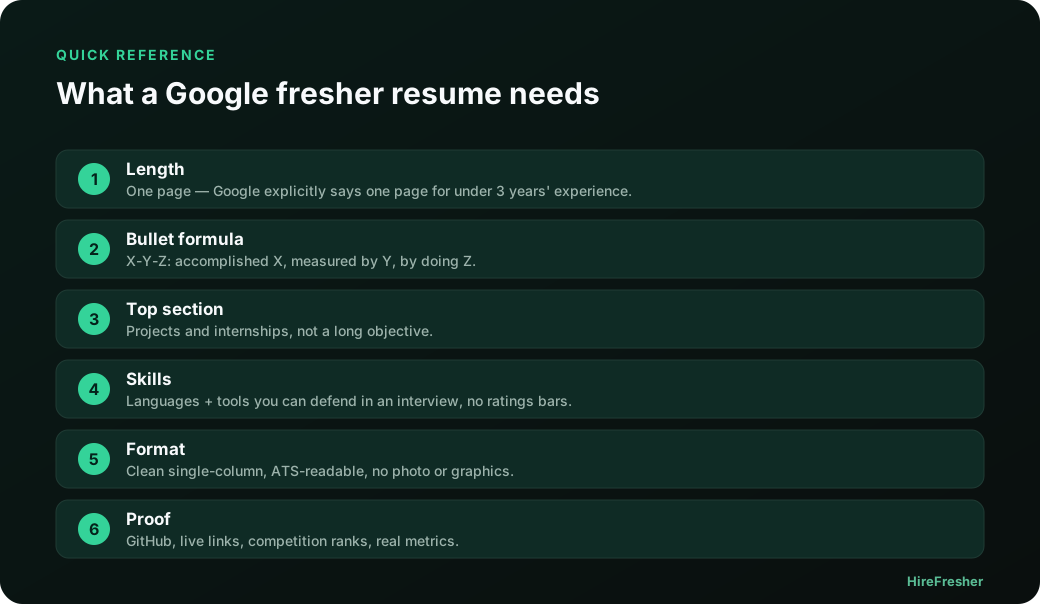
This is the single most useful tip Google has ever shared publicly, and freshers ignore it constantly. Google's ex-SVP of People Operations, Laszlo Bock, put it plainly: frame every bullet as "Accomplished [X] as measured by [Y] by doing [Z]."
In plain terms — what did you achieve, what's the number that proves it, and how did you do it. Most fresher resumes only write the Z part ("did X using Java") and leave out the result entirely.
Compare these two lines from a real fresher project:
- Weak: "Made a college attendance app using Flutter and Firebase."
- X-Y-Z: "Cut manual attendance time by ~70% for a 240-student department by building a Flutter + Firebase app now used by 6 faculty members."
- Weak: "Participated in a hackathon."
- X-Y-Z: "Placed 3rd of 48 teams at Smart India Hackathon by building a crop-price predictor that hit 84% accuracy on a 2-year dataset."
Put projects and internships above everything
For a fresher, your project section is your experience section. Google reviewers spend the most time here because it's the closest thing they have to seeing how you actually work.
List 2–3 strong projects, each with 2–3 X-Y-Z bullets, a one-line tech stack, and a link (GitHub, a live demo, or a Play Store listing). Depth beats a list of ten half-finished repos. If a project involved a real user, a real dataset, or a real deadline, say so — that's the ambiguity-and-ownership signal Google looks for.
If you're unsure how to phrase the outcome and impact, our guide on how to write a project description in a resume walks through it bullet by bullet, and fresher resume examples shows full layouts you can model.
Keep it to one page — Google says so
Google's careers site literally recommends one page for candidates with less than three years of experience. For a fresher that isn't a suggestion, it's the expectation. A two-page fresher resume reads as "can't prioritise."
To fit one page without cramming: drop the long career objective, cut generic soft-skill lists, and remove any project that doesn't have a real outcome. A crisp two-line summary is fine; a five-line objective is not. If you still want an objective, keep it sharp — see career objective for freshers for tight examples.
One page also forces the discipline Google wants. Every line has to earn its space, which is exactly the editing judgment that separates a shortlisted resume from a rejected one.
Make it ATS-readable — even at Google
Big companies, Google included, run applications through parsers and keyword filters before a human sees them. Fancy templates with columns, icons, text boxes, and photos are where fresher resumes quietly break.
Stick to a clean single-column layout, standard section headings (Experience, Projects, Education, Skills), and a normal font. No photo, no rating bars, no tables inside tables. If you want to understand why this matters, read what is an ATS resume, then run your draft through our free ATS checker to catch parsing issues before you apply.
Match your skills language to the job description too. If the role says "data structures, algorithms, distributed systems," and you have that, use those exact words — don't paraphrase them into something the filter won't recognise.
The skills and education section, done right
List only skills you can defend in a 45-minute interview. Google will test your top languages and CS fundamentals, so putting "expert in 9 languages" is a trap, not a flex. Group them simply: Languages, Frameworks/Tools, CS core (DSA, OS, DBMS, OOP).
Education stays short: degree, institute, graduation year, and CGPA if it's roughly 8.0+ or above your branch average. Add coursework only if it's directly relevant (Machine Learning, Operating Systems) and skip school marks once you're in college.
Certifications and competitive-programming profiles (LeetCode, Codeforces, a strong GitHub) belong here too if they're real and active — a link to a 1600+ Codeforces profile says more than any adjective.
Build it fast without a paid service
You do not need to pay ₹2,000 for a "Google-optimised" resume writer. Almost all of that so-called optimisation is the free advice in this article, marked up.
Use our free resume builder for freshers to build, preview, and download our ATS-friendly templates at no cost in India (unlimited downloads, every template). Downloads are paid only for users outside India (from $5) — a fraction of what agencies charge, and you keep full control of the content.
For the underlying structure, our ATS resume format for freshers and general how to write a resume for freshers guide give you the skeleton; this article gives you the Google-specific edge to fill it.
FAQs
Does Google really prefer a one-page resume for freshers?
Yes. Google's own careers guidance recommends one page for anyone with under three years of experience, which covers every fresher and intern applicant. Keep it tight and let projects do the talking.
What is the X-Y-Z resume formula Google recommends?
It's Google's advice to write bullets as: accomplished [X] as measured by [Y] by doing [Z]. In short — the achievement, the number that proves it, and how you did it. It forces every line to show impact, not just tasks.
Do I need work experience to apply to Google as a fresher?
No. Google's STEP and Software Engineering internships and university-grad roles are built for students. Strong projects, competitive-programming profiles, and internships stand in for full-time experience — present them with real metrics.
Will a creative or colourful template hurt my Google application?
It can. Google screens applications through parsers, and multi-column, icon-heavy, or photo templates often break parsing. Use a clean single-column ATS-friendly layout and run it through an ATS checker before applying.
Should I pay someone to write my Google resume?
Usually not. Most paid 'Google-optimised' services just repackage free advice like the X-Y-Z formula and one-page rule. A free builder plus this guide gets you 95% there — and on HireFresher every template is free in India (downloads are paid only for users outside India, from $5).
Sources & verification
Recruitment stages, eligibility, and assessment patterns can vary by role, location, campus, and hiring drive. Always confirm the latest details on the official source before you apply:
Google — official careers page
Last verified: 12 Jul 2026 · Reviewed by Ritesh Panda
Build your resume free
Create your free ATS-friendly resume in minutes using our free resume builder.
Create free resumeJob Alerts
Get new resume tips & fresher job-prep guides — free, no email needed.