
Cybersecurity Resume for Freshers (2026)
17 Jul 2026 · 8 min read
Written by Anil Sahu · Reviewed by Ritesh Panda
Last reviewed: 17 Jul 2026
Cybersecurity is one of the most in-demand fields in India — but it's also one where freshers struggle most to prove they can actually do the work. A degree alone rarely gets you shortlisted; recruiters want evidence of hands-on skill.
The good news: even without a job, you can build a genuinely strong cybersecurity resume using the right certifications, home-lab projects, and keywords. This guide breaks down exactly what to include, how to layer your skills so a recruiter sees real depth, and how to keep it ATS-friendly so the software doesn't drop you before a human ever reads it.
Why Cybersecurity Resumes Are Different
Security roles are skill-first. Recruiters and their ATS scan for specific tools, certifications, and hands-on evidence — so a vague 'passionate about cybersecurity' line won't cut it. You have to show what you've actually done, in the language the job posting uses. (Formatting basics: What Is an ATS Resume?)
Entry-level security roles (SOC analyst, security trainee) also attract huge application volume, so keyword matching matters a lot. If the posting says 'SIEM' and 'incident response' and your resume only says 'security tools', you may never surface. Mirror the exact terms, then check your draft with the free ATS checker.
Build Your Skill Stack From the Ground Up
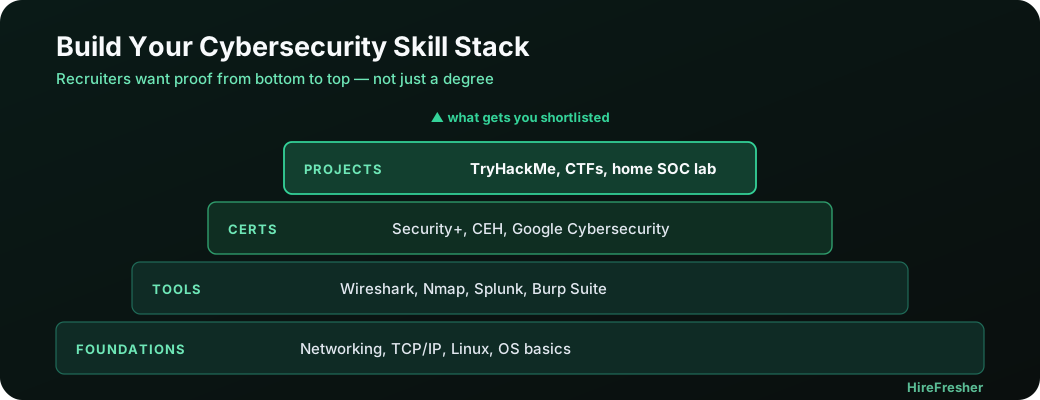
The strongest fresher cybersecurity resumes read like a stack: solid foundations at the base, tools on top, certifications above that, and hands-on projects at the peak — the part that actually gets you shortlisted. Think of it as a pyramid a recruiter can climb in five seconds.
Keywords & Certifications That Matter
- Roles: SOC Analyst, Security Analyst Trainee, Information Security Intern.
- Skills: Networking, TCP/IP, Linux, SIEM, firewalls, vulnerability assessment, incident response.
- Tools: Wireshark, Nmap, Splunk, Metasploit, Burp Suite.
- Certifications: CompTIA Security+, CEH, or the Google Cybersecurity Certificate.
Show Hands-On Proof
The single biggest thing that separates a shortlisted cybersecurity fresher from the pile is evidence of practice. A degree and a cert say you learned; a project says you did. List platforms and projects: TryHackMe or HackTheBox rooms completed, a home SOC lab you built, a CTF you competed in, or a small vulnerability write-up.
Describe each one the same way you'd describe any strong resume project — what you did, the tool you used, and what you found or fixed. For example: 'Completed 30+ TryHackMe rooms covering network and web exploitation' or 'Set up a home SOC lab with Splunk to detect simulated brute-force attacks'. This is the exact action + tool + result structure that works for every field.
If you have a GitHub with security scripts or write-ups, link it. Recruiters for security roles genuinely click through — a public trail of practice is worth more than another buzzword in your skills list.
Format Mistakes That Cost Interviews
- Two-column 'techie' templates with icons — they break ATS parsing. Stay single-column.
- A skills dump with no proof — pair every claimed skill with a project or cert.
- Listing tools you can't actually use — you will be asked about them in the interview.
- Burying certifications at the bottom — for security roles, put them near the top.
Your First 90 Days: Building Proof With No Job
If your resume feels thin, the fix isn't more buzzwords — it's 90 days of visible practice. Here's a simple plan you can finish alongside college that fills every section with real evidence.
Month 1 — Foundations: get comfortable with networking, TCP/IP, and Linux, and start CompTIA Security+ prep. Month 2 — Tools and hands-on: work through TryHackMe or HackTheBox rooms and learn Wireshark, Nmap, and a bit of Splunk. Month 3 — Build and document: set up a small home SOC lab, complete a CTF, and write up what you did on GitHub or a blog.
At the end you'll have real projects, a certification in progress, and a public trail of work — which turns 'no experience' into a resume that clearly reads as job-ready. List each milestone as a project with the tool used and what you found or fixed.
This plan also gives you honest interview stories. When a recruiter asks 'tell me about a time you investigated something', you'll have a real lab or CTF to describe instead of a textbook definition — and that is what actually converts a shortlist into an offer.
Final Tips
Keep it single-column and ATS-safe, lead with skills and certifications, and back everything with hands-on projects. That combination is what turns 'no experience' into 'clearly job-ready' for an entry-level security role.
Build your cybersecurity resume free on HireFresher and run it through the ATS checker before applying. For the underlying technical skills to feature, see our guide to the best technical skills for IT freshers.
7 Cybersecurity Resume Examples (Copy & Adapt)
Recruiters skim cyber resumes for proof you have actually touched the tools. Swap in your own labs, certs, and numbers — these lines show the shape that gets shortlisted:
- SOC analyst angle: "Monitored simulated network traffic in a home SOC lab using Splunk and Wireshark; wrote 5 detection rules that flagged brute-force and port-scan attempts."
- VAPT: "Ran a vulnerability assessment on OWASP Juice Shop using Burp Suite and Nmap; documented 12 findings mapped to the OWASP Top 10 with remediation steps."
- Home lab: "Built a 3-VM lab (Kali, Metasploitable, Windows AD) on VirtualBox to practise privilege escalation and AD attacks, with a GitHub write-up per exploit."
- Practice platforms: "Completed 40+ TryHackMe rooms and the Jr Penetration Tester path; top 10% on my college cyber club leaderboard."
- Certifications: "CompTIA Security+ (2026) and Google Cybersecurity Professional Certificate; currently preparing for CEH."
- Scripting: "Automated log analysis with a 120-line Python script that extracts failed SSH logins from auth.log and emails a daily summary."
- Skills line: "Network security, SIEM (Splunk), Nmap, Wireshark, Burp Suite, Linux, Python, OWASP Top 10, incident-response basics."
FAQs
How do I write a cybersecurity resume with no experience?
Lead with skills and certifications, then prove them with home-lab and CTF projects (TryHackMe, HackTheBox), described with the tool used and what you found. Hands-on evidence matters more than a job title you don't have yet.
Which certification is best for a cybersecurity fresher?
CompTIA Security+ is the most widely recognised entry-level cert. CEH and the Google Cybersecurity Certificate also help. List whichever you hold, aligned to the role's keywords.
What skills should a fresher cybersecurity resume list?
Networking and TCP/IP, Linux, SIEM tools, firewalls, vulnerability assessment, and incident response — plus tools like Wireshark, Nmap, and Splunk. Only list what you can actually discuss in an interview.
Do cybersecurity recruiters check my GitHub or TryHackMe?
Often, yes. A public trail of write-ups, scripts, or completed rooms is strong proof of hands-on skill, so link it and describe your best work on the resume itself.
Should a cybersecurity resume be ATS-friendly?
Yes. Entry-level security roles get high volume, so use a single-column, keyword-matched format and check it with a free ATS checker before applying.
Build your resume free
Create your free ATS-friendly resume in minutes using our free resume builder.
Create free resumeJob Alerts
Get new resume tips & fresher job-prep guides — free, no email needed.